About This Topic
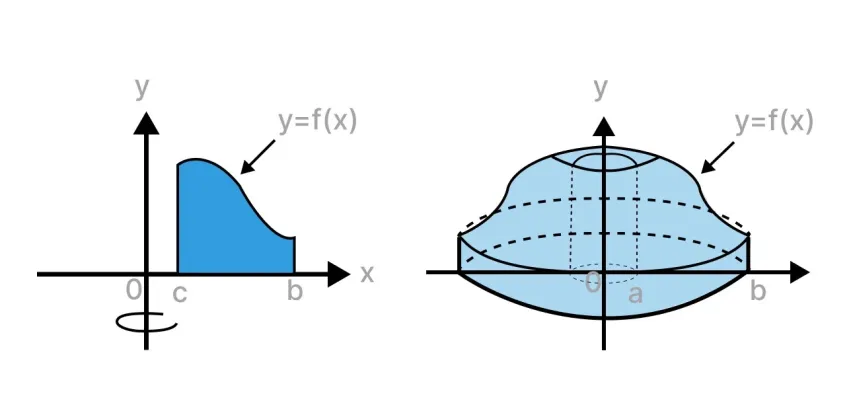
Solids of rotation (or solids of revolution) are three-dimensional objects formed by rotating a two-dimensional shape around an axis. This mathematical concept allows us to understand and calculate the volumes and properties of many common objects like spheres, cylinders, and cones.
This topic is divided into three parts:
Part 1: Introduction to Solids of Rotation
Learn the fundamental concepts of solids of rotation, including common examples like cylinders, cones, spheres, and tori. Explore their mathematical properties and applications in calculus.
View Part 1Part 2: Visualizing Solids of Rotation
Explore the axis of rotation concept in detail and understand real-world applications like the lathe machine. Learn key terminology and see visual representations of solids of rotation.
View Part 2Part 3: Advanced Concepts
Dive into calculus applications with disk, washer, and shell methods. Explore Pappus-Guldinus theorems, non-standard axes of rotation, and engineering applications of solids of rotation.
View Part 3Note: Understanding solids of rotation is important for various applications in mathematics, physics, and engineering. These concepts are particularly useful in calculus when calculating volumes using integration methods.
Key Mathematical Concepts
- Axis of Rotation: The line around which a 2D shape is rotated to create a 3D solid.
- Disk Method: An integration technique used to find volumes when rotating around the x-axis.
- Shell Method: An integration technique used to find volumes when rotating around the y-axis.
- Cross-Section: The shape formed when slicing through a solid perpendicular to an axis.
Concepts based on standard mathematical principles. Visualizations inspired by materials from various educational resources.