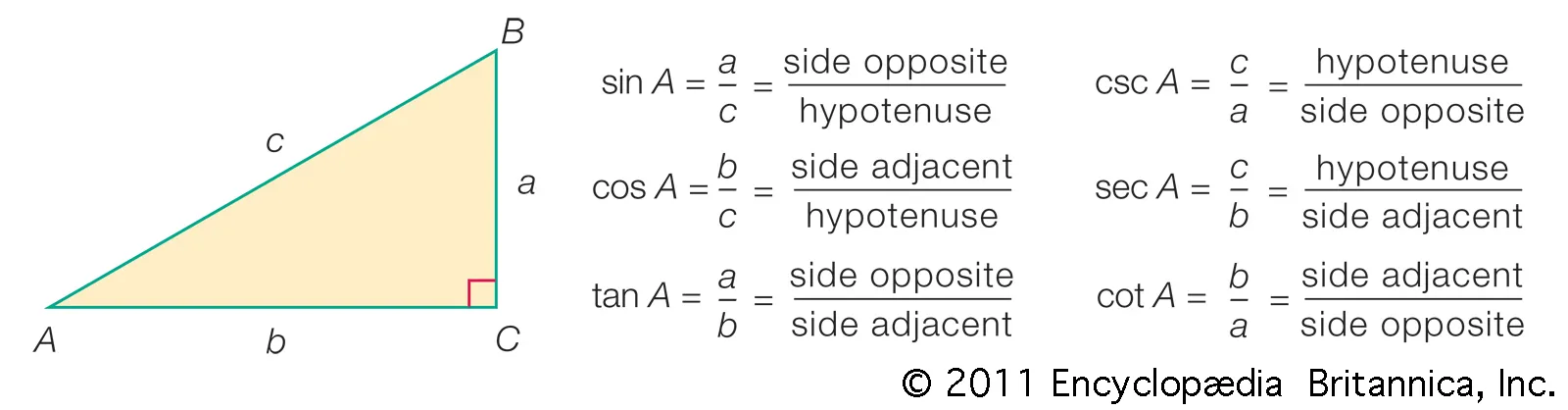
In mathematics, a trigonometric function is one of six functions (sine [sin], cosine [cos], tangent [tan], cotangent [cot], secant [sec], and cosecant [csc]) that represent ratios of sides of right triangles. These six trigonometric functions in relation to a right triangle are displayed in the figure above.
They are also known as the circular functions, since their values can be defined as ratios of the x and y coordinates of points on a circle of radius 1 that correspond to angles in standard positions.
Key Relationship
The fundamental trigonometric identity is:
This identity is derived from the Pythagorean theorem.
Basic Formulas
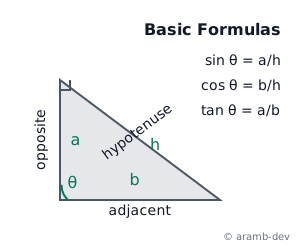
| θ | = | angle theta |
| a | = | length of opposite side a |
| h | = | length of hypotenuse h |
Primary Trigonometric Functions
$\sin \theta = \frac{\text{opposite}}{\text{hypotenuse}}$
$\cos \theta = \frac{\text{adjacent}}{\text{hypotenuse}}$
$\tan \theta = \frac{\text{opposite}}{\text{adjacent}} = \frac{\sin \theta}{\cos \theta}$
$\csc \theta = \frac{1}{\sin \theta}$
$\sec \theta = \frac{1}{\cos \theta}$
$\cot \theta = \frac{1}{\tan \theta}$
In mathematics, the trigonometric functions are real functions which relate an angle of a right-angled triangle to ratios of two side lengths. They are widely used in all sciences that are related to geometry, such as navigation, solid mechanics, celestial mechanics, geodesy, and many others.
Applications
Trigonometry can be easily applied to surveying, engineering, and navigation problems in which one of a right triangle's acute angles and the length of a side are known and the lengths of the other sides are to be found.
Certain intrinsic qualities of the trigonometric functions make them useful in mathematical analysis. In particular, their derivatives form patterns useful for solving differential equations.